
Local Belgian farmer supported by Colonel Gustave

Educational read · 6 minutes

Local vs industrial dog food: what a short supply chain really changes.

€3 per month difference between industrial dog food and a short supply chain alternative. We show you, no nonsense, what those €3 are really worth.

True story

Some brands are taking us for fools.

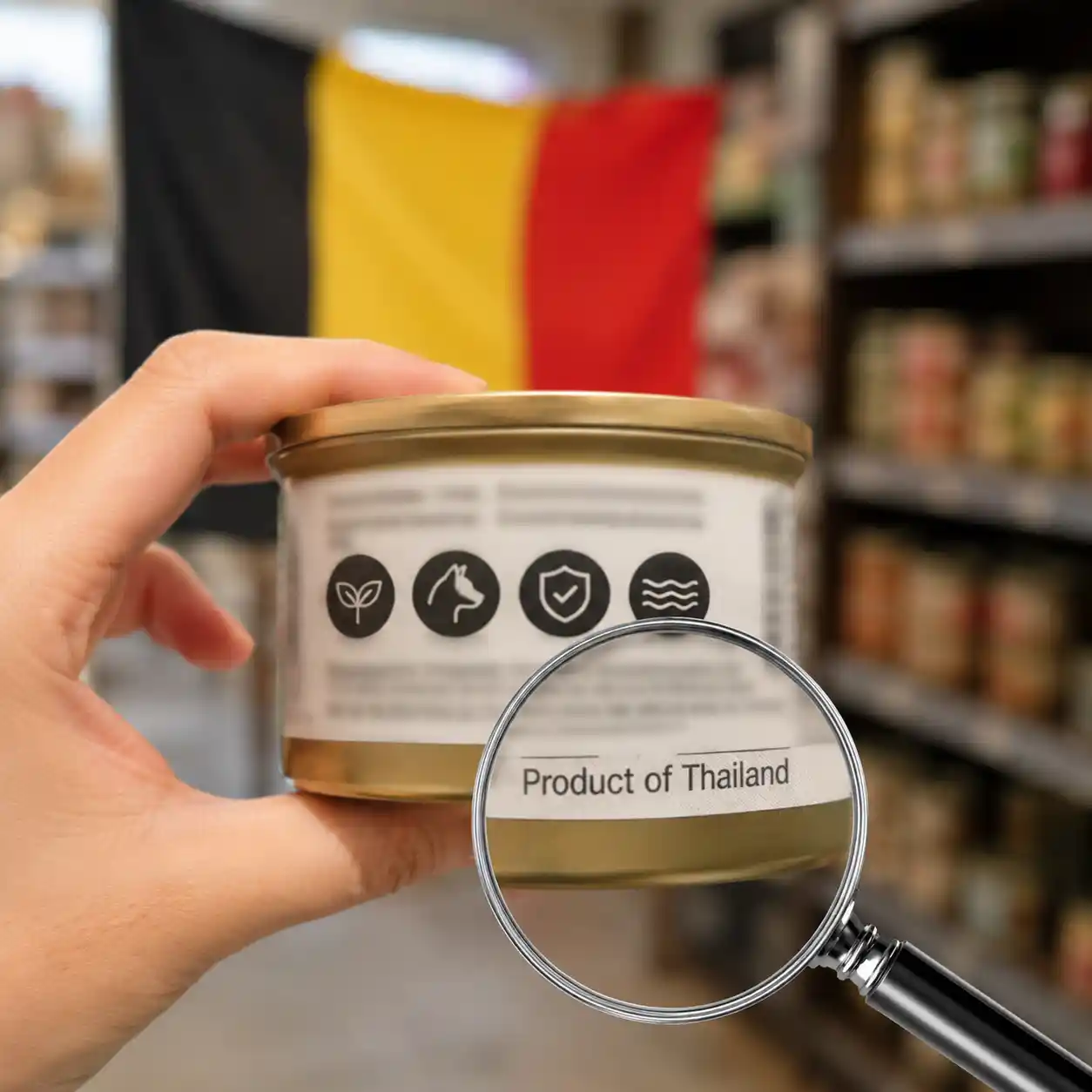
Pet food packaging with a Belgian flag on the front but 'Product of Thailand' marked on the back

Belgian flag prominently displayed. Product of Thailand on the back.

Belgian flag on the shelf. Belgian flag on every product. Belgian flag on the pâté. Everything is designed to mislead.

You flip the tray over. Product of Thailand, in this example.

That's what we call misleading the consumer, plain and simple.

Some go even further, offering rice and salmon recipes with a Belgian flag on the bag. Just so you know: there's no rice or salmon available in Belgium ;-)

And it's not just a Belgian problem. The same happens in France: products labelled "made in France" but actually produced in Eastern European countries.

The reality of pet food

The map of an industrial bag.

Here's what your dog eats when you choose "the cheapest option".

Chicken
China
~ 9,000 km
Fresh lamb
England
~ 600 km
Dehydrated lamb
New Zealand
~ 19,000 km
Fish (salmon)
Norway
~ 2,000 km
Cereals
Ukraine
~ 2,000 km
Flax seeds
Turkey
~ 3,000 km

Potential cumulative distance

35,000 km

of ingredients travelling the world in a single bag of industrial dog food.

Our dogs eat at 160 km.

The real match-up

Industrial vs short supply chain.

Criterion by criterion, here's what truly changes.

Industrial
Imported ingredients, sometimes from outside the EU. Vague traceability.
vs
Short supply chain
95% within a 160 km radius. Identified producers.

Origin — A bag that's travelled the world, or a bag that comes from down the road.

Industrial
"Animal by-products", dehydrated proteins with no species specified.
vs
Short supply chain
Belgian chicken as fresh meat: 42 kg per 100 kg of kibble.

Protein — We don't hide behind a vague catch-all term.

Industrial
"Cereals", "oils and fats": generic wording with no specifics.
vs
Short supply chain
Clear list, with the name and function of every ingredient.

Transparency — If we can't name it precisely, we don't put it in.

Industrial
Producer → buying centre → factory → wholesaler → retailer → you. 5 middlemen.
vs
Short supply chain
Producer → Colonel Gustave → you. Just 1 middleman.

Supply chain — The shorter, the clearer.

Industrial
Ultra-processing. Flavours, enhancers, preservatives to compensate.
vs
Short supply chain
Simple recipe. When ingredients are good, you don't need to cheat.

Processing — Fewer tricks, more real food.

Industrial
Attractive price. But variable quality and long-term health impact to monitor.
vs
Short supply chain
~€3 more per month. But a recipe that genuinely nourishes.

Price — The real question is value for money over the long term.

Section 1

Origin of ingredients: knowing what your dog actually eats.

With dog food made through a short supply chain, transparency is total: we know what's in the bag, and above all where it comes from.

For us, it's simple. 95% of our ingredients come from within a 160 km radius of our production site in Andenne, Belgium. Which means:

  • Chicken comes from identified Belgian farms.
  • Vegetables (carrots, pumpkin, tomatoes) are grown locally.
  • Fibres (chicory, oats, nettles) are European.
  • Omega-3 comes from microalgae cultivated in Europe (no imported salmon).

Industrial dog food, on the other hand, often uses ingredients sourced from several different countries — sometimes from outside the European Union. The cheapest chicken comes from China. Cereals from Ukraine. Dehydrated lamb from New Zealand.

The verdict: local traceability brings a level of trust that imported production simply can't offer. And it's verifiable.

Section 2

Protein quality: fresh meat or by-products?

Protein is the heart of any dog food. And it's also where brands play the most word games.

In a well-designed short supply chain recipe, we choose proteins that are highly digestible and nutritious, sourced from clearly identified raw materials:

  • Fresh meat (and not "dehydrated", which can hide a lot).
  • Muscle, premium cuts — no generic "animal by-products".
  • Animal origin clearly stated on the label.

For us specifically: 42 kg of fresh Belgian chicken per 100 kg of kibble. That's a verifiable figure, not a marketing slogan.

Industrial dog food tends to favour "animal by-products", a very broad category that can include nutritionally less interesting parts. On the label, this translates into vague wording: "animal by-products", "dehydrated animal proteins" with no species mentioned.

The verdict: these ingredients aren't necessarily harmful, but transparency and quality are not comparable.

Section 3

Recipe transparency: actually reading the label.

Transparency is one of the major advantages of a short-supply-chain brand. A well-built recipe seeks above all to be understandable and honest. It limits unnecessary ingredients and clearly details:

  • The origin of raw materials.
  • The type of meat used (and not just "meat" full stop).
  • Nutritional "extras" like microalgae, plants or fibres.

Everything is designed so that you can read the label in 30 seconds and understand exactly what your dog is eating.

By contrast, some industrial dog foods use very generic wording like "cereals", "oils and fats" or "animal by-products", without specifying their nature.

Our rule: if we can't name it precisely, we don't put it in the recipe.

Section 4

Environmental impact: dog food that doesn't travel around the world.

Behind a bag of industrial dog food often lies a long journey. Raw materials may come from several countries, be processed elsewhere, packaged in another location, then transported to the final retailer.

Each stage adds kilometres… and an extra carbon footprint.

Conversely, short-supply-chain dog food naturally limits environmental impact. By working with ingredients close to the production site, we reduce:

  • Distances travelled by ingredients (around 160 km instead of several thousand).
  • Unnecessary transport between intermediaries.
  • Excessive packaging.
The ratio: up to 35,000 km cumulated in an industrial bag, vs 160 km here. The planet wins too.

Section 5

Processing and additives: feeding or "compensating"?

Industrial dog foods often have one thing in common: they're heavily processed. When the quality of raw materials varies, there's a strong temptation to add elements to compensate:

  • Artificial flavourings.
  • Taste enhancers.
  • Colourings.
  • Preservatives.

These additions don't serve to feed your dog. They serve to make the food more palatable or more shelf-stable, despite an average base recipe.

By contrast, short-supply-chain dog food prioritises a simple recipe, based on quality ingredients from the start. When the raw materials are good, you don't need to cheat.

Our principle: less artifice, more real food.

Section 6

Digestion, skin, coat: the daily impact in the bowl.

Diet has a direct and visible effect on a dog's wellbeing. What they eat every day influences:

  • The quality and regularity of stools.
  • Their energy levels.
  • The condition of their skin and coat.
  • The frequency of digestive issues (gas, diarrhoea, vomiting…).

Well-formulated short-supply-chain dog food, rich in digestible ingredients and quality proteins, can really make a difference. It contributes to:

  • Improved digestive tolerance.
  • Reduced episodes of very loose stools.
  • A shinier coat and healthier skin.

Conversely, industrial dog foods made with by-products, low-quality cereals or excessive additives can, in some sensitive dogs, contribute to digestive or skin issues.

Section 7

Price: looking beyond the receipt.

At first glance, industrial dog food may seem cheaper. But to compare properly, you need to look at several elements:

  • The price per kilo, not the price of the bag.
  • The actual nutritional value (and not just the displayed composition).
  • The impact on long-term health (and therefore vet bills).
  • The amount needed: quality food fills your dog faster, so you use less.

Short-supply-chain dog food costs slightly more upfront — about €3 more per month for an average dog. But it feeds better, avoids filler ingredients, and can even reduce certain costs over the long term.

The real question: €3 per month for what exactly? You know the answer now.

Section 8

Supporting the local economy: what's behind a bag.

Behind short-supply-chain dog food, there's much more than just a recipe. You'll find:

  • Farmers who supply the ingredients.
  • Carriers who work on a small scale.
  • Production teams rooted in the region.
  • Families who live directly from this know-how.

Buying from a short supply chain therefore means:

  • Keeping value-added in the region, instead of seeing it leave for a foreign head office.
  • Encouraging more respectful and transparent practices.
  • Allowing producers to keep innovating and improving their recipes.

Imported industrial dog food, on the other hand, often benefits very large international groups, and only a limited share of that value actually returns to the local economy.

Section 9

How to spot truly local dog food.

Some brands call themselves "local", but not all of them really are. To tell the difference, a few simple questions help clarify things:

  • Does the manufacturer indicate precisely where the food is produced?
  • Is the origin of the main ingredients clearly explained?
  • Does the brand work with identified producers (farms, local cooperatives, named partners)?
  • Can you easily contact the manufacturer with questions?
  • Is there consistency between the messaging (local, sustainable, healthy) and the ingredient list?
  • When you turn the bag over, are they telling you the truth? (You now know why this question is essential.)
Our signal: if several answers remain vague, there's something to hide.

Our signature

A thousand times purer than fish oil.

At Colonel Gustave, our omega-3 doesn't come from tired Norwegian salmon. It comes from microalgae cultivated in Europe: no heavy metals, no overfishing, with 50% more EPA & DHA. This is the new benchmark.

Discover our supply chain in detail →
Want to see how we put all this into practice?

Our supply chain, our producers, our 160 km map, our concrete commitments: we show you everything.

Discover Colonel Gustave →

FAQ

Your questions about Belgian dog food.

What is short-supply-chain dog food?
Short-supply-chain dog food is made from ingredients sourced primarily from producers close to the production site (farms, cooperatives, local processors). The origin of raw materials and the place of production are clearly indicated, ensuring full traceability and a limited number of intermediaries between the producer and your dog's bowl. At Colonel Gustave, that's 95% of ingredients within a 160 km radius around Andenne, Belgium.
What's the concrete difference with industrial dog food?
Short-supply-chain dog food prioritises traceable ingredients (known origin), higher-quality proteins (identified fresh meat, no "animal by-products"), and simpler recipes with fewer additives. Industrial dog food, mass-produced, often uses raw materials imported from multiple countries (China, New Zealand, Norway…), less transparent wording, and may be ultra-processed with flavourings and taste enhancers.
Is local dog food really more expensive?
Slightly, yes: about €3 more per month for an average dog. But it often offers better value for money: more nutritious recipes, fewer filler ingredients, better digestion (fewer stools, fewer issues), and potential long-term savings on the dog's health. The real question isn't "what costs less", but "what do I want for my dog".
How can you spot real local dog food?
Check that the manufacturer clearly states where the food is produced, that the origin of main ingredients is specified, that the brand works with identified producers (farms, local cooperatives), and that the manufacturer is easy to contact. Beware of decorative flags: always turn the bag over and look for "Product of..." mentions that reveal the true origin. If several answers remain vague, there's something to hide.

In summary

Choosing local means choosing clarity.

€3 more per month, for a dog who eats within 160 km instead of 35,000. For a recipe we can actually explain. For a Belgian producer we can name. And for a brand that doesn't hide behind a flag.

Now, the choice is yours.

Nous acceptons

Bancontact Paypal apple pay mastercard visa
logo artisan
My cart

50€

Free delivery

75€

Gifted treat

99€

Omega Booster Oil gifted